|
|
|
|
|
 The
National Conferences
The
National Conferences
on Primary Health Care Access
Introduction
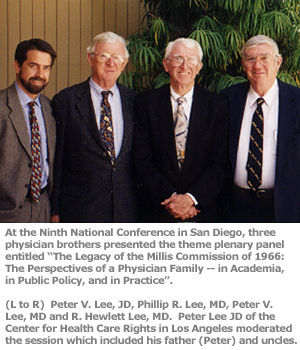
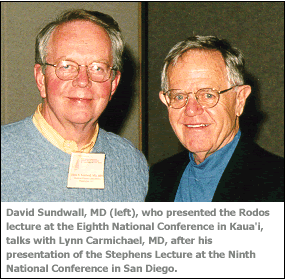
In 1990, a group of persons interested in family and community medicine, medical school reform, and advocacy for rural, inner city and other geographical areas of need, were invited to rural Wisconsin for the First National Conference on Primary Health Care Access. Since then, similar groups have been invited to assemble each Spring. Over the years, many of the pioneers, key strategists, researchers and policy makers who have promoted the idea of community-responsive medical education have participated in one or more of the National Conferences. (Many have participated in seven or more of the nine conferences held.)
The National Conferences have continuity in the conference faculty from year to year. The conferences are limited to approximately 60 participants. Persons who enroll in the conference series are invited to renew their space in each subsequent conference.
Beginning with next Spring's conference in Bethesda, the National Conferences will incorporate National Grand Rounds, a special part of the conference is devoted to particular subjects of national interest. The multi-institutional structure for developing the National Grand Rounds, will be the National Research Consortium on Community-Based Medical Education, an affiliated activity of the National Conference Series.
The founding members of the Research Consortium include the Departments of Family and Community Medicine of the University of Illinois, Rockford and Southern Illinois University [Decatur Family Practice], the Departments of Family Medicine at Charles R. Drew University, Wright State University, and Oklahoma State University College of Osteopathic Medicine, the Division of Family Medicine at the University of California San Diego, and the Department of Family Practice at the University of Kentucky.
 Policy
Background
Policy
Background
Lack of access to health care is a problem in most rural, inner-city, lower socioeconomic, and minority communities. That lack of access is in part due to the decline in the numbers of general practitioners and family physicians and the increase in medical subspecialists, who typically do not locate in inner city or rural areas. The subspecialization of medicine increased in every decade of the 20th century. That specialization appears to be accelerating, and with it the decline in percentage of primary care providers when compared with subspecialists. (Many areas continue to experience an absolute decline in numbers of primary care providers.)
Trends suggest that current levels of funding for primary care activities are inadequate for turning the tide of subspecialization, and such new resources as might be commanded are marginal. The most hopeful approach is likely to be the encouragement of strategies for increasing the cost-effectiveness of current levels of effort and the forging of strategic linkages between health care sectors such as primary care training programs, community-based health care delivery systems and primary health care professionals specifically trained to practice in communities of chronic physician shortage.
Such strategies and such linkages are the content of the National Conferences.Click here for Conference Cancellation Policy
|
|
|
|
| Copyright 1998-2001 Coastal Research Group. All rights reserved. |