|
|
 |
|
|
||
|
|
||
|
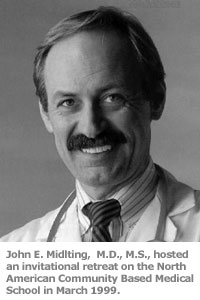
This National Project seeks to provide an analysis, reflecting current economic throught, of the impact of various revenue streams to academic medical centers during the 20th century to the structure of those medical centers and to the physician workforce that they in the aggregate produce. Among the outcomes of the National Project will be discussion and proposals as to how policy-makers in corporate non-profit and government settings can and should alter incentives and revenue streams to medical education so as to impact the future physician workforce. An Invitational Retreat was held in Cancun on March 29-31, 1999 to develop the outline of a book on the past and future financing streams for the doctoral and postdoctoral training of community- and family-oriented physicians. The book is intended to present analytical and historical information produced by the National Project on the intended and unintended consequences of past public policy. The book will outline a prescription for re-incentivizing the current system to improve health care delivery in an economically realistic way.
|
|
|
|
 NATIONAL
PROJECT ON THE FUNDING
NATIONAL
PROJECT ON THE FUNDING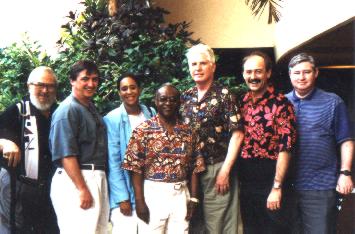 Members
of the National Project editorial board meeting at the Salon Isla
Contoy in Cancun: (From Left to Right) J.Jerry Rodos,
DO, Midwestern University; John G. Bradley, MD, Southern Illinois
University; Lorena Chicoye, MD,GWU Health Systems, Bethesda; Ludlow
B. Creary, MD, MPH, Charles R. Drew Unversity, Los Angeles; William
H. Burnett, MA, National Project Staff; John E. Midtling, MD, MS,
University of Illinois, Rockford; Charles E. Henley, DO, Oklahoma
State University-College of Osteopathic Medicine, Tulsa.
Members
of the National Project editorial board meeting at the Salon Isla
Contoy in Cancun: (From Left to Right) J.Jerry Rodos,
DO, Midwestern University; John G. Bradley, MD, Southern Illinois
University; Lorena Chicoye, MD,GWU Health Systems, Bethesda; Ludlow
B. Creary, MD, MPH, Charles R. Drew Unversity, Los Angeles; William
H. Burnett, MA, National Project Staff; John E. Midtling, MD, MS,
University of Illinois, Rockford; Charles E. Henley, DO, Oklahoma
State University-College of Osteopathic Medicine, Tulsa.|
|
 |
|
Copyright 1998-2002 Coastal Research Group. All rights reserved. |