|
|
|
|
|
NATIONAL PROJECT ON THE
OUTCOMES
OF FAMILY PRACTICE RESIDENCY TRAINING
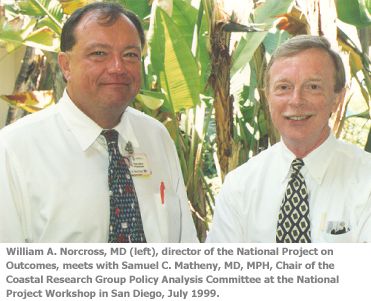
William A. Norcross,
MD
Department of Family and Preventive Medicine
University of California, San Diego; Project Leader
The National Project on the Outcomes of Family Practice Residency Training is a joint initiative of the National Conferences on Primary Health Care Access and the Coastal Research Group's Research and Data Base Management Committee and Policy Analysis Committee.
The National Project seeks to characterize the impact that family practice residencies have had on the distribution of family physicians geographically, the range of settings in which family physicians work, the population groups they serve, and the effect the graduates of the training programs have had on the health status of general and specific population categories.
Several components comprise the National Project. First, the Project is incorporated into a "National Grand Rounds on Strategic Programs Designed to Impact the Geographic Distribution of Physicians". The National Grand Rounds was first presented at the Tenth National Conference on Primary Health Care Access in Bethesda, Maryland on March 26, 1999. Second, the Coastal Research Group's annotated bibliography on family practice graduate studies, published in 1989, is being updated as part of the literature review for the National Grand Rounds.
The Family Practice Residency Graduate Data Base
The ongoing activity of the National Project will be a series of studies utilizing the Coastal Research Group's Family Practice Residency Graduate Data Base, which comprises the names, practice locations and background information on over 4500 graduates of family practice residency programs in California.
On August 24, 1999 the first meeting of the National Project on Outcomes took place in Los Angeles. This provided the first opportunity for a group of interested researchers on family practice residency outcomes to assess the research potentials of the Family Practice Residency Graduate Data Base. Later meetings of the National Project in Los Angeles occurred on February 22, 1999 in Los Angeles July 19, 1999 in San Diego, and October 11, 1999 in San Francisco.
The Origins of the Data Base
The first accredited family practice residency programs were approved in 1969, two (of 13 nationally) in California. In the mid-1970s an initiative began to keep track of all of the graduates from the California programs indefinitely. Under the sponsorship of Doctor Sanford Bloom, then of the Santa Monica Hospital family practice residency program, funds were secured to work with each of the existing California residency programs (as well as a program which had closed in 1974) to obtain complete lists of the names of each program's graduates, and, to the extent possible, relevant background information on each graduate.
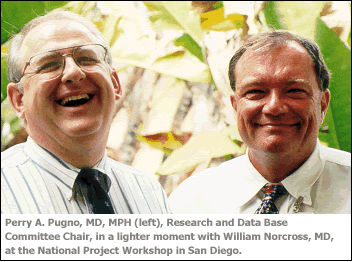
With funding from a grant from the American Academy of Family Physicians Foundation in Kansas City, Missouri, the data thus obtained were computerized. By 1983, the amount of data was sufficient to warrant the creation of a non-profit organization, the Coastal Research Group, to be custodian of the data base. Dr. Bloom was elected the organization's president and Doctor John Blossom of the University Medical Center program in Fresno was elected the chairman of the Research and Data Base Management Committee. Its current chair is Doctor Perry A. Pugno of the American Academy of Family Physicians in Kansas City.
 The
Structure and Philosophy of the Data Base
The
Structure and Philosophy of the Data Base
From the beginning, the data base was constructed to permit longitudinal studies of the long-term impact of family practice residency training. However, the data base was structured from the beginning to assure that it would be a confidential resource to the training programs, rather than public data. Thus, rules were established preventing the identification of individuals in the data base or to permit a comparison of the graduates of one training program's graduates to another's. The rules permitted qualified researchers to apply to the Research and Data Base Management Committee for access to the data base. But no data were available for use by accreditation or funding agencies.
The data base actually is several interlinked data bases. The principal data base is comprised of some 50 fields of data on each residency program graduate. The fields include the name, unique identifier code for that graduate, year of graduation and number of years in training program. The mailing address and practice address are recorded as two separate fields, with some geographic data on the practice address, including the county, census tract and state-recognized geographic unit (through which considerable socioeconomic data on the practice's surrounding community are available). Two fields of data describe the type of practice and practice specialty. (Although most family physicians practice the specialty, a few have chosen to become specialists in other fields of medicine.)
The graduate's high school, high school city and state (the principal proxy for where the graduate spent formative years) and medical school of graduation are included. Other data fields record birthyear, race/ethnicity and gender. If the graduate received a Certificate of Added Qualifications (CAQ) in geriatrics or sports medicine that is recorded, as is any other category of post-residency fellowships that become known to the data base managers. Also included is information on the data of initial certification by the American Board of Family Practice and latest re-certification.
Interlinked with the principal data base are other data bases that were established by means of Coastal Research Group Questionnaires in point of time. All such questionnaires, including a major one to all physicians in the data base in 1987-88, contained an identifying code that permits a researcher to add considerable supplementary material, including questions on scope of practice, both in clinical and hospital settings, and the graduate's perception of the relevance of his or her training program curricula to the practice situation. One advantage of the linking each questionnaire to the main data base (as opposed to sponsoring anonymous questionnaires) is that the non-respondents to any question can be characterized by other data in the principal data base.
Maintenance of the Data Base
Maintenance of the accuracy of a data base with such large numbers requires considerable effort on the part of the Coastal Research Group, working with each participating residency program, to make certain that the practice addresses and other data are current and accurate. This includes cross-referencing the data base against various national data bases (while making certain that accurate data are not replaced by obsolete or wrong information which can be found in national and institutional records).
As one example of the problems, the data managers must work around, until 1997, board certification data had been obtained by comparing annual editions of the American Board of Family Practice's directory of diplomates. The decision of the Board to cease publishing the diplomate book in 1997 has added new challenges to keeping these data fields current. A meeting with Board officials to find an adequate solution to this dilemma took place in Lexington in August 1999.
Use of Data Base by National Project on Outcomes
No other set of data on family physicians provides such rich opportunities for analysis of the impact of family practice training over time. It is a prospective, rather than retrospective data base, in that every person in the category of family practice residency graduate in California is contained in it, whether or not they remain in the specialty, retire or die. The high school data provides information on where the graduate was raised. (Although no study has begun yet that seeks to obtain it, information on the demographics of each high school by class year is available nationally). The data base is linked to socioeconomic information on the medical school and community of residency. Socioeconomic data exist on the communities in which the graduates practice. Both past and future questionnaires to the graduates can be used to supplement the general data.
|
Terms Ending September 30, 2000: |
Terms
Ending September 30, 2001: |
Terms
Ending September 30, 2002: |
|
|
Arch Mainous III,
Ph.D. Perry A. Pugno,
MD, MPH (Chair) |
John C. Payne,
MD John A. Zweifler,
MD |
Kevin Pearce, MD Joseph E. Scherger,
MD, MPH |
|
| Emeritus Members: | |
| H. John Blossom,
MD (Chair, 1983-1991) |
William A. Norcross, MD (Chair, 1991-1997) San Diego, California |
|
|
|
|
| Copyright 1998-2001 Coastal Research Group. All rights reserved. |