|
|
|
|
|
 THE
NATIONAL CONFERENCES
THE
NATIONAL CONFERENCES
ON PRIMARY HEALTH CARE ACCESS
Introduction
In 1990, a group of persons interested in family and community medicine, medical school reform, and advocacy for rural, inner city and other geographical areas of need, were invited to rural Wisconsin for the First National Conference on Primary Health Care Access. Since then, similar groups have been invited to assemble each Spring. Over the years, many of the pioneers, key strategists, researchers and policy makers who have promoted the idea of community-responsive medical education have participated in one or more of the National Conferences. (Many have participated in eight or more of the ten conferences held.)
The National Conferences have continuity in the conference faculty from year to year. The conferences are limited to approximately 60 participants. Persons who enroll in the conference series are invited to renew their space in each subsequent conference.
In March 1999, in Bethesda, the National Conferences presented the first two National Grand Rounds, a special part of each conference devoted to particular subjects of national interest. The multi-institutional structure for developing the National Grand Rounds, is the National Research Consortium on Community-Based Medical Education, an affiliated activity of the National Conference Series.
The founding members of the Research Consortium include the Departments of Family and Community Medicine of the University of Illinois, Rockford and Southern Illinois University [Decatur Family Practice], the Departments of Family Medicine at Charles R. Drew University, Wright State University, and Oklahoma State University College of Osteopathic Medicine, the Division of Family Medicine at the University of California San Diego, and the Department of Family Practice at the University of Kentucky.
Policy Background
Lack of access to health care is a problem in most rural, inner-city, lower socioeconomic, and minority communities. That lack of access is in part due to the decline in the numbers of general practitioners and family physicians and the increase in medical subspecialists, who typically do not locate in inner city or rural areas. The subspecialization of medicine increased in every decade of the 20th century. That specialization appears to be accelerating, and with it the decline in percentage of primary care providers when compared with subspecialists. (Many areas continue to experience an absolute decline in numbers of primary care providers.)
Trends suggest that current levels of funding for primary care activities are inadequate for turning the tide of subspecialization, and such new resources as might be commanded are marginal. The most hopeful approach is likely to be the encouragement of strategies for increasing the cost-effectiveness of current levels of effort and the forging of strategic linkages between health care sectors such as primary care training programs, community-based health care delivery systems and primary health care professionals specifically trained to practice in communities of chronic physician shortage.
Such strategies and such linkages are the content of the National Conferences.
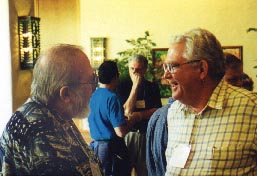
At right, Paul R. Young, M.D., of the American Board of Family Practice, Lexington, Kentucky, talks with J. Jerry Rodos, D.O..
Dr. Young presented the 10th G. Gayle Stephens Lecture in Kaua'i. Dr. Rodos was dean of Chicago College of Osteopathic Medicine and is presently consultant to the director of the National Health Service Corps.Named Lecture Series
The National Conferences have established named lecture series to honor three colleagues. The G. Gayle Stephens Lectures (established in 1991) center on reforms in the practice of medicine and health care. The previous Stephens Lecturers have been Doctors Alfred O. Berg of the University of Washington; F. Marian Bishop of the University of Utah; Lynn Carmichael of the University of Miami; Ronald Goldschmidt of the University of California, San Francisco; John E. Midtling of the University of Illinois, Rockford; Charles E. Odegaard of the University of Washington; David Satcher, United States Assistant Secretary for Health and Surgeon General; Joseph E. Scherger of the University of California, Irvine; and G. Gayle Stephens of the University of Alabama, Birmingham.
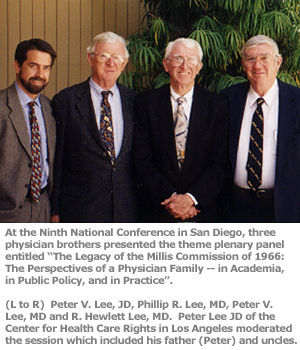
The Charles E. Odegaard Lectures (established in 1994) center on reforms in academic medical centers. The previous Odegaard Lecturers have been Doctor Mark E. Clasen of Wright State University, Dayton; Peter V. Lee of the University of Southern California; David Marsland of Virginia Commonwealth University Medical College of Virginia; Daniel Ostergaard of the American Association of Family Physicians, Kansas City; J. Jerry Rodos of Midwestern University, Downers Grove, Illinois; and Emery Wilson of the University of Kentucky.
The J. Jerry Rodos Lectures (established in 1995) center on the subject of community-based medical education and practice. The previous Rodos Lecturers have been Bruce Behringer of East Tennessee State University, Johnson City; and Doctors Hector Flores of White Memorial Medical Center, Los Angeles; Count D. Gibson, Jr. of Stanford University; Sandral Hullett of West Alabama Health Services, Selma and the University of Alabama; and David Sundwall, President, American Clinical Laboratories Association and former AdminIstrator, Health Resources and Services Administration.
|
|
|
|
| Copyright 1998-2001 Coastal Research Group. All rights reserved. |