|
|
|
|
|
 The
National Conferences on Primary Health Care Access is committed to the national
goal of 100% access to primary health care services. The following statement,
which has evolved out of the National Conferences, is presented by one of its
most effective advocates for Primary Health Care Access, Doctor Marc E. Babitz
of the University of Utah. The statement defines the content and attributes
of primary health care.
The
National Conferences on Primary Health Care Access is committed to the national
goal of 100% access to primary health care services. The following statement,
which has evolved out of the National Conferences, is presented by one of its
most effective advocates for Primary Health Care Access, Doctor Marc E. Babitz
of the University of Utah. The statement defines the content and attributes
of primary health care.
Primary Health Care:
a complete, working definition
By Marc
E. Babitz, MD and
the Members of the Coastal Research Group Communications
and Publications Committee
What is primary health care? Or, more importantly, what should primary care
be? Consumers (including patients, employers, and insurance companies) regularly
purchase primary care, but what are they, or should they, be buying? National
health care planners suggest that our nation needs more primary care providers,
but what are the qualities that should define this type of provider?
Many individuals and organizations have offered definitions of primary care.
The original definition of primary care from Kerr White was based solely on
the location where the care was provided, but such a definition is too limited
for current needs. Barbara Starfield, in her 1992 book Primary Care: Concept,
Evaluation and Policy, wrote that primary care consists of four key components:
first contact, continuity of care, comprehensiveness, and coordination. However,
this definition lacks the breadth to encompass the whole of primary care. A
complete and useable definition of primary care is important so that consumers
and state and federal policy makers have a means of truly identifying and evaluating
organizations and individuals who wish to portray themselves as primary care
providers, as well as to assist educators in directing and evaluating the training
of future primary care providers.
For the past ten years, there has been an annual conference on National Primary
Health Care Access. This conference series was designed as a meeting with continuity
which brings together a fairly consistent group of individuals who are active
in primary health care as providers (clinical and administrative), educators
(of students and residents), and policy makers (private and governmental) from
around the nation. A result of these conferences has been the preparation and
updating of consensus statements on numerous issues relevant to primary health
care access in the United States. This group of experts has recommended that
a more complete, and more useable, definition of primary care be adopted, as
follows: Primary health care is defined as health care which has six essential
qualities -- accessible, acceptable, accountable, comprehensive, coordinated
and continuing.
Before examining in detail this definition of primary health care, it is important
to emphasize some points specifically excluded from this definition. First,
it purposefully avoids defining primary care by the specialty of the provider
giving the service. Such a definition is overly simplistic and stereotypical
in assuming that all providers of a given discipline or specialty have practices
which reflect all six of the required qualities. For example, there are primary
care providers, such as family physicians, who work solely in emergency rooms
or urgent care centers. Those practice settings, and therefore, that provider,
are not able to meet the six requirements of a complete definition of primary
care. The second important exclusion is the quality of first contact.
Because there are so many
potential entry points into our national health care system, the primary care
experts from the National Conference series believe that where, or with whom,
an individual enters the health care system is not an important determinant
of whether that individual is receiving primary care. Likewise, location is
not used in the definition, since primary care services which meet the above
six qualities may occur in a variety of settings.
The remainder of this article will fully clarify what is meant by each of the
six essential qualities of primary health care as recommended by the consensus
statement of the National Primary Health Care Access group. The first is that
primary health care should be accessible. This means that providers and
systems of primary care must identify and address barriers that prevent patients
from receiving their care. The traditional barriers that exist include financial,
geographical, cultural, and availability.
Financial barriers that need to be addressed are those that limit access
to care for patients without insurance (currently over 41 million Americans)
as well as those with less lucrative insurance coverage -- which often includes
Medicaid and Medicare patients. Geographical barriers that need to be
addressed include assuring that appropriate services are available in remote
or isolated communities and that services are easily reached (e.g., located
near bus routes, provide transportation services, offer adequate, on-site parking).
Cultural barriers that need to be addressed include the availability
of staff with language and translation skills appropriate to the populations
being served and that this staff has received training in improving their individual
and organizational cultural competence (both in general and specific to the
cultural groups being served). In this context, culture recognizes the important
differences affecting health care in individuals based upon ethnic background,
religious background and beliefs, gender, age, extent of exposure to the dominant
culture, educational achievement, socio-economic status, and health beliefs.
Availability issues that need to be addressed include the presence of
an adequate number of primary care providers, thereby avoiding prolonged and
inappropriate waiting times and ensuring that all desiring individuals are able
to have a primary care provider. Also, health care services must be offered
at times which meet the needs of the patients (which may include evening and/or
weekend hours), preventing excessive and inappropriate utilization of non-primary
care providers, such as those in emergency rooms and urgent care centers.
 The
second quality is that primary care should be acceptable. This is a more
difficult concept to describe and measure, yet it is critically important to
the provision of effective and efficient health care. Primary health care needs
to be provided in the context of a patient's cultural and socio-economic realities.
When health care is not provided within this context, the results are often
unexpected.
The
second quality is that primary care should be acceptable. This is a more
difficult concept to describe and measure, yet it is critically important to
the provision of effective and efficient health care. Primary health care needs
to be provided in the context of a patient's cultural and socio-economic realities.
When health care is not provided within this context, the results are often
unexpected.
In such cases, the health care provider frequently attributes the failure of
their treatment plan to non-compliance by the patient when in actuality the
provider's care plan was doomed to failure from the beginning. For example,
a common cause for frail, elderly patientsí inability to take prescribed
medications is their physical inability to open their child-proof medicine bottles
and their difficulty in differentiating between pills of similar size, color
and shape.
A second example comes from providers of health care for migrant farmworkers
and their families, who have learned that medications prescribed (or provided)
to their patients should not require refrigeration because many of these patients
do not have access to a refrigerator. In both examples, the patient's alleged
non-compliance was due to an unacceptable plan by the provider.
The third quality of primary care is that it should be accountable, specifically
in terms of cost and quality. Primary health care must be concerned with the
cost of recommended interventions, whether for diagnosis or treatment. Costs
must be considered within the context of whether an intervention has the potential
to positively change an outcome and must include the patient's value judgement
on whether the intervention can personally be considered cost-effective.
Quality assessment in health care has been limited in its penetration into primary
care, despite the fact that the majority of health care encounters occur in
this setting. Primary care providers need to incorporate ongoing quality improvement
programs into their practices because of the improved patient care that is provided
and not because it is mandated by some outside agency.
The fourth quality of primary care is that it should be comprehensive.
This quality extends beyond the traditional services offered by a health care
provider. Primary care providers are encouraged to consider the "one-stop
shopping" concept for their patients and try to maximize the breadth of
services which are made available in their practice. Comprehensiveness is maximized
by the team approach to health care which has been demonstrated in both the
private sector (e.g., some HMOs) and the public sector (e.g., community health
centers). Many of these programs offer laboratory, radiological, nutritional,
psychological, dental and other services. Community health centers often include
financial services such as eligibility determinations for Medicaid coverage
and social services.
The fifth quality of primary care, coordinated care, recognizes that
primary care providers cannot provide all the services required of their patients,
despite their best efforts to be truly comprehensive. The classic type of coordination
is with sub-specialty providers to meet the more complex medical needs of patients.
However, equally important is coordination with a wide variety of social support
systems which meet complex patient needs important to their health care. For
example, if we agree that adequate nutrition, adequate shelter, and adequate
protection from violence are important aspects of a patient's health status,
then primary care providers need to know how to access these services (or provide
them in their own practice).
The sixth, and final, quality of primary care is that it is continuing.
Primary care should be about building therapeutic relationships with patients
over time. There already is a body of literature that demonstrates that continuity
of care leads to improved preventive health services and improved patient compliance.
A major challenge to our current primary care delivery systems is the loss of
this therapeutic relationship. This can be blamed on the large size of primary
care groups, the instability of insurance coverage, requiring patients to frequently
change providers, and the policies of health care delivery systems which do
not value continuity.
Primary care should be seen as more complex than just a defined location or
specialty type. By describing the essential qualities of primary care, this
complete definition encourages a more functional view of this important component
of our health care system. Health care planners, health care payors, health
care purchasers, health professions educators and health care providers are
encouraged to adopt this complete definition as they plan, offer, buy, teach
or deliver primary care services.
About the Author
Marc E. Babitz, MD
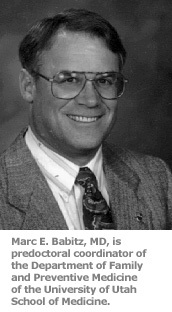
Dr. Babitz is the predoctoral coordinator of the Department of Family and Preventive Medicine of the University of Utah School of Medicine. While a family practice resident in the early 1970s, Dr. Babitz established a National Health Service Corps [NHSC] site in rural Guerneville, California and in 1974 became the first student/resident member of the California Health Manpower Policy Commission.
Subsequently, he became a commissioned officer in the United States Public Health Service, serving at NHSC headquarters in Rockville, Maryland and as regional medical officer in Denver.
About the Chair of the
Communications and Publications Committee
Mark E. Clasen, MD, Ph.D.
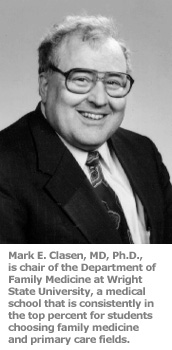
Dr. Clasen is chair of the Department of Family Medicine at Wright State University in Dayton, a community-oriented medical school that consistently ranks at or near the top in the percentage of medical students choosing family medicine and primary care careers. The department has been co-sponsor of the last six National Conferences and is a member of the National Research Consortium on Primary Health Care Access.
Dr. Clasen, who was on medical school faculties in Mississippi and Texas before assuming the Chair at Wright State, presented the Third Charles E. Odegaard Lecture on "the Culturally Competent Physician" at the Seventh National Conference in Williamsburg in 1997.
|
Terms Ending |
Terms
Ending September 30, 2001: |
Terms
Ending September 30, 2002: |
||
|
Sandral Hullett,
MD, MPH Gary LeRoy, MD |
Stephen Wilhide Allan Wilke, MD |
Chales Henley,
DO Gerald L. Ignace,
MD |
||
Emeritus Members: |
||||
Norman B. Kahn, MD (Chair, 1983-1989) Kansas City, Kansas |
Michael D. Prislin, MD (Chair, 1989-1996) Irvine, California |
|||
|
|
|
|
| Copyright 1998-2001 Coastal Research Group. All rights reserved. |